Awards Are Footnotes, Not Foundations: Anish Kanjilal’s Stirring Message at Adamas University
“A crown does not make a king and a Genius blooms in silence”
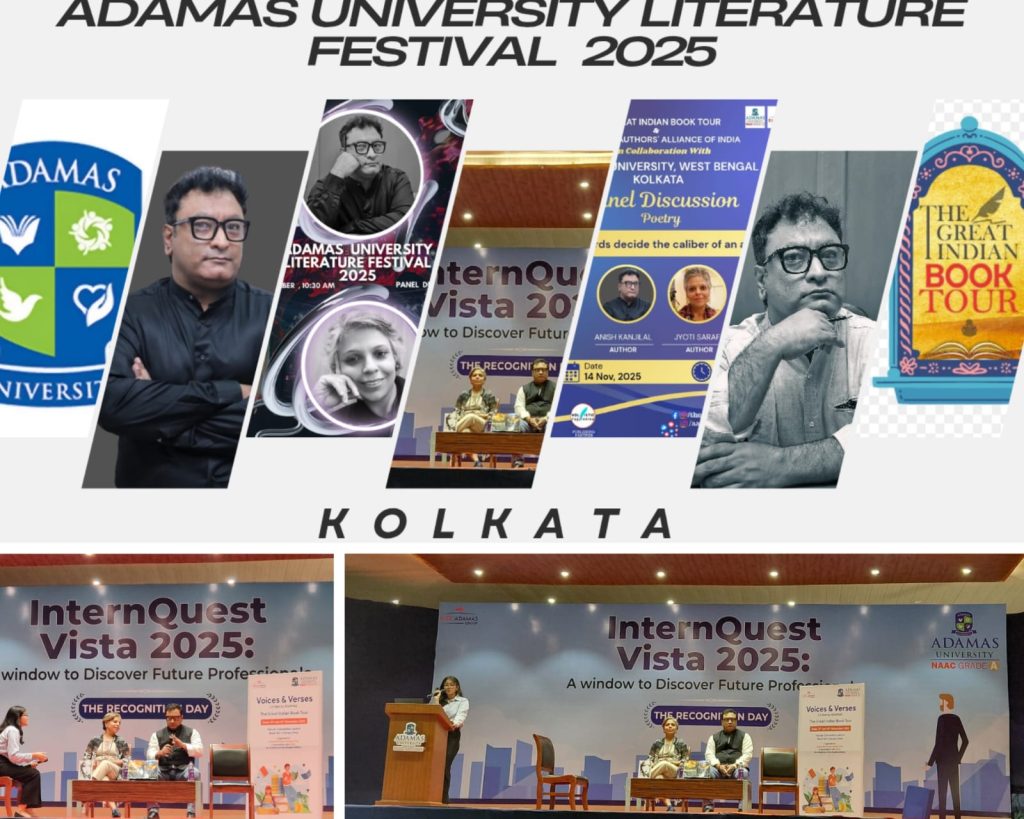
At a thought-provoking literary panel hosted by Kolkata’s renowned Adamas University, celebrated author and educator Anish Kanjilal delivered a powerful address that challenged one of the most enduring assumptions in the creative world: Do awards truly define an author’s worth?
Kanjilal—best known for his acclaimed books Fateless 13 and 11 Oracles, and recipient of honors including the Rajasthan Patrika Literary Award (2009), the National Education Forum’s Best Educator Award (2024), and the Best Poet Award at the Kolkata Literary Carnival (2025)—stood before an eager audience not to celebrate his accolades, but to dethrone them.
Despite a career adorned with recognition, the Founder and Director of Educare – The Institute used his platform to redirect attention to what he believes is the true legacy of any writer: their ideas, their words, and the worlds they create.
When Great Minds Reject Great Awards
One of the most compelling moments of Kanjilal’s address came when he revisited the legacies of literary giants who stood defiantly apart from the award culture.
He spoke of George Bernard Shaw, the first individual to have won both an Oscar and a Nobel Prize. Shaw, who famously insisted that “Art should not please; art should preach,” refused the Nobel Prize in 1926—calling it an insult—and later declined to collect his Academy Award as well. The Oscar, he quipped, could hardly justify the long journey to retrieve it. It was later sent to him and, as lore has it, ended up as a doorstop.
Kanjilal then invoked Jean-Paul Sartre, who turned down the Nobel Prize in Literature on the grounds that he did not want to be “institutionalized” or shaped by official recognition. These examples, he noted, remind us that the worth of a writer is measured not by medals, but by the courage and originality of their thought.
Tagore, Shakespeare, and the Immortal Power of Ideas
Moving closer to home, Kanjilal reflected on Rabindranath Tagore, whose Gitanjali found global acclaim thanks to the advocacy of artist William Rothenstein and the endorsement of W.B. Yeats. Tagore’s Nobel Prize was historic—but Kanjilal reminded the audience that even without it, Tagore’s literary influence would remain colossal.
He then turned to William Shakespeare, revered across centuries despite the complete absence of formal literary awards in his era. Shakespeare unknowingly pioneered psychological concepts—paranoia, psychosis, guilt—through characters like Hamlet and Macbeth long before psychology became a formal discipline in 1879. And yet, his works endure, studied and performed more than 400 years later.
“Shakespeare didn’t need trophies,” Kanjilal noted. “His readers became his legacy.”
The Bias Behind Many Modern Awards
Kanjilal also offered an incisive critique of how geography, politics, and institutional bias influence modern awards.
The Pulitzer Prize is limited strictly to American citizens.
The Costa Book Awards cater only to writers based in specific regions.
Such restrictions, he argued, often shrink the global literary conversation and exclude deserving voices. Some institutions, he added with a smile, even organize competitions only to reward themselves—an irony not lost on the audience.
Genius Recognized Only After Death
Highlighting the tragic disconnect between awards and true talent, Kanjilal invoked the case of H.P. Lovecraft, the father of cosmic horror who died in poverty and obscurity. Only after his death did the world recognize his pioneering genius—another reminder that awards often fail to detect brilliance in real time.
A Call to Bring Modern Voices Into the Classroom
Kanjilal concluded with a compelling appeal: modern educational curricula must make room for contemporary writers. While classical authors remain vital, he argued that today’s students need literature that reflects the complexities, fears, aspirations, and realities of the modern world.
“A Writer Lives Through Ideas, Not Medals.”
In his closing words, Kanjilal returned to the theme that framed his entire address:
“Awards can encourage, but they cannot define. A writer lives through their ideas, their characters, their stories—not through the medals they collect.”
At a time when society often measures success through trophies and titles, Anish Kanjilal’s message at Adamas University offered a refreshing reminder: literature finds its true power not in recognition, but in connection—the quiet, intimate exchange between writer and reader.
And it is that bond, he insisted, that endures long after awards gather dust.
Journalist Details

- Jitendra Kumar is an Indian journalist and social activist from Hathras in Uttar Pradesh is known as the senior journalist and founder of Xpert Times Network Private Limited.
Latest entries
 Bharat StoriesDecember 27, 2025Dream Capture India: Empowering New-Age Talent with Genuine & Professional Opportunities Across India
 Bharat StoriesDecember 27, 2025Awards Are Footnotes, Not Foundations: Anish Kanjilal’s Stirring Message at Adamas University
 NewsDecember 26, 2025Second Hindu Man Lynched in Bangladesh Amid Unrest — Government Says It Was Not a ‘Communal Attack’
 Bharat StoriesDecember 26, 2025DJ Japs Named Best DJ Of 2025 for His Impactful Performances and Global Reach