Between Silence and Sightings: The Unanswered Questions Around Gen Naravane’s Missing Book
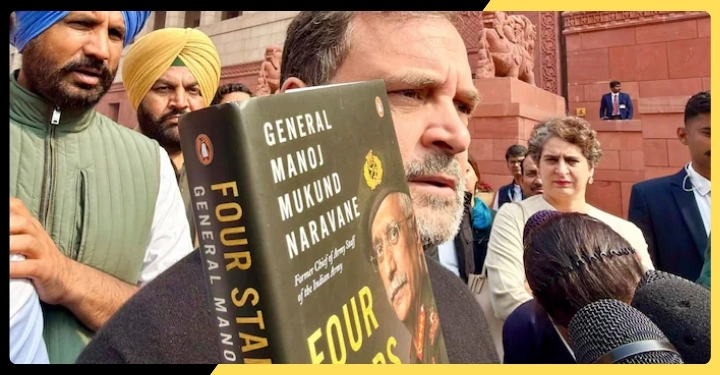
Few controversies emerge from absence alone. Yet the debate surrounding an alleged book by former Indian Army Chief General M.M. Naravane has done precisely that—drawing attention not to what has been published, but to what may never see the light of day. The strange part is not that a book has been delayed or canceled. It is that journalists insist they saw it, while the publisher insists it never existed.
The contradiction has created an unusual information vacuum, one filled rapidly by speculation. Initial reports described a manuscript in advanced stages, one that combined personal leadership reflections with professional experiences at the helm of the Indian Army. The tone, according to those familiar with it, was measured rather than explosive. There were no sensational allegations, no overt political critiques. And yet, something appears to have gone seriously awry.
When the publisher’s denial surfaced, it was not framed as a clarification but as a clean erasure. No project. No manuscript. No discussions. Such categorical language raised more questions than it answered. If there was never a book, why were so many people convinced there was one? And if there was one, why go to such lengths to deny it?
Those who have covered military affairs for decades note that books by serving or recently retired chiefs occupy a uniquely sensitive space. Even when written with discretion, they inevitably intersect with unresolved policy debates, border tensions, and civil-military dynamics. In that context, perception matters as much as content. A book that appears harmless internally can be interpreted very differently once its existence becomes public knowledge.
Sources familiar with publishing practices suggest the manuscript may have reached a stage where it was informally shared—read by editors, peers, or advisors—without crossing the threshold of formal acceptance. From a legal standpoint, that gives a publisher room to deny ownership. From a journalistic standpoint, it still qualifies as a real, seen document.
There is also the question of timing. The period following General Naravane’s retirement coincided with heightened geopolitical sensitivities. Any personal account from a former Army Chief would be scrutinized for what it says—and what it omits—about recent events. Even neutral observations can be framed as implicit commentary. In such an environment, pulling back may have seemed prudent.
The silence from General Naravane himself has been striking. Neither confirming nor denying the book’s existence, he has allowed the confusion to persist. Some interpret this as restraint, others as strategy. In the absence of an authoritative statement, the narrative has fractured into competing versions of reality.
What complicates matters further is the modern media ecosystem, where partial information spreads quickly and corrections rarely travel as far. Once reports of the book appeared, they took on a life of their own. The publisher’s denial, rather than closing the matter, only amplified curiosity. After all, denials are rarely issued for things no one believes exist.
At its core, the controversy reflects a deeper tension between transparency and control. Military leaders are increasingly expected to engage with the public, to share insights and experiences. At the same time, institutional caution remains strong. Navigating that balance is difficult, and missteps—real or perceived—can lead to abrupt reversals.
For now, the alleged book remains suspended between confirmation and erasure. It has no ISBN, no release date, no official acknowledgment. Yet it has already influenced conversations about leadership, accountability, and the limits of public disclosure.
Whether the manuscript is eventually released, rewritten, or permanently shelved may matter less than what this episode reveals: that in today’s information age, even silence can speak loudly—and even a book that “doesn’t exist” can leave behind a trail too visible to ignore.
Journalist Details

- Jitendra Kumar is an Indian journalist and social activist from Hathras in Uttar Pradesh is known as the senior journalist and founder of Xpert Times Network Private Limited.
Latest entries
 Latest NewsMarch 30, 2026Bihar CM Nitish Kumar Quits Legislative Council Seat, Triggers Debate Over Political Strategy
 Latest NewsMarch 28, 2026Jewar Airport Opens: PM Modi Flags Off Major Infrastructure Milestone
 Bharat StoriesMarch 27, 2026Amit Dhore aka Crazy Vibe Music Emerges As Top Indian DJ In UAE For 2026
 Bharat StoriesMarch 26, 2026Naman Jain Becomes One Of India’s Most Promising Stand Up Comedian Of 2026