Big Relief for AAP Leaders as Court Throws Out Liquor Policy Case, Cites Lack of Evidence
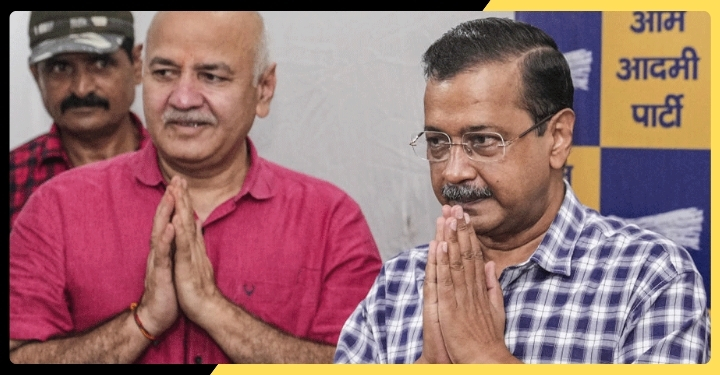
In a dramatic legal reversal, a Delhi court has discharged Chief Minister Arvind Kejriwal, former Deputy Chief Minister Manish Sisodia, and other accused in the controversial liquor policy case, citing insufficient evidence and significant investigative shortcomings. The ruling offers substantial relief to the Aam Aadmi Party (AAP), which has consistently described the case as politically driven.
The excise policy case stemmed from allegations that the Delhi government’s 2021–22 liquor policy was designed to confer undue advantages on select private players in exchange for kickbacks. The Central Bureau of Investigation (CBI), which took over the probe, had claimed that irregularities in the policy’s drafting and execution resulted in financial losses to the exchequer while benefiting certain stakeholders.
However, after reviewing the charge sheet and accompanying material, the court concluded that the prosecution had not established a prima facie case strong enough to proceed to trial. In its detailed order, the judge observed that while the allegations were serious, they were not supported by clear, admissible evidence directly linking the accused to criminal misconduct.
The court was particularly critical of the manner in which the investigation was conducted. It flagged discrepancies in witness statements and noted the absence of a clearly traceable money trail to substantiate claims of illicit financial transactions. The order emphasized that criminal charges cannot be framed on the basis of assumptions or unverified assertions.
Defense lawyers argued that policy decisions are inherently subject to debate and revision, and that withdrawing or modifying a policy does not imply criminal intent. They contended that the prosecution had conflated administrative decisions with criminal conspiracy without demonstrating concrete proof of wrongdoing. The court appeared to accept this reasoning, reinforcing the principle that legal culpability requires more than political controversy.
The ruling triggered strong reactions across the political spectrum. AAP leaders welcomed the decision as a decisive rebuttal of what they described as a campaign of harassment. Party members said the discharge vindicated their claim that investigative agencies were being used to stifle opposition voices.
On the other hand, the CBI maintained that its investigation had been conducted professionally and in accordance with the law. Officials indicated that the agency would examine the court’s findings before deciding on its next steps, including the option of challenging the order in a higher judicial forum.
Legal analysts say the court’s observations about investigative lapses could have broader implications. The ruling underscores the judiciary’s role as a safeguard against potential overreach and highlights the importance of rigorous standards in criminal investigations, especially in politically sensitive matters.
For Kejriwal and Sisodia, the discharge represents not only legal relief but also a potential political boost. With the case having cast a long shadow over the party’s governance narrative, the court’s decision may help AAP recalibrate its public messaging ahead of future electoral contests.
While the possibility of further legal proceedings remains, the immediate outcome shifts the momentum in favor of the accused. More broadly, the judgment reiterates that in a system governed by the rule of law, allegations must ultimately withstand judicial scrutiny — and that the burden of proof rests squarely on the prosecution.
Journalist Details

- Jitendra Kumar is an Indian journalist and social activist from Hathras in Uttar Pradesh is known as the senior journalist and founder of Xpert Times Network Private Limited.
Latest entries
 Latest NewsMarch 1, 2026Protesters Breach Barriers at U.S. Consulate in Karachi; Security Forces Fire Tear Gas, Eight Killed
 Latest NewsMarch 1, 2026Ancestry and Diplomacy: How Khomeini’s Indian Link Re-enters Debate After Iran’s Power Shift
 NewsFebruary 28, 2026Banknote Shipment Ends in Disaster as Air Force Plane Goes Down in Capital
 NewsFebruary 27, 2026Kolkata Shaken by Sudden Tremors, Panic Grips Office-Goers