
Raging Waters and Broken Lives: How Assam Is Battling Its Most Destructive Flood Crisis
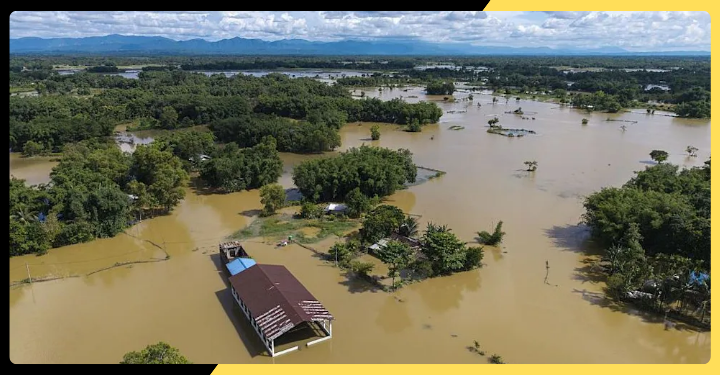
Assam is once again confronting a devastating flood emergency that has left entire communities struggling to survive. Triggered by relentless monsoon rains and overflowing rivers, the disaster has submerged hundreds of villages, displaced thousands of people, and caused extensive damage to homes, roads, farmland, and public infrastructure. For many residents, this year’s floods are among the worst they have experienced in decades.
The mighty Brahmaputra River, often called Assam’s lifeline, has once again become the source of immense destruction. Fed by heavy rainfall in Assam and neighbouring states, the river and its tributaries swelled rapidly, breaching embankments and inundating low-lying areas. Water levels rose so quickly that many families had only minutes to escape before their homes were engulfed.
Across several districts, rescue teams from the National Disaster Response Force (NDRF), State Disaster Response Force (SDRF), Indian Army, Air Force, and local authorities launched large-scale evacuation operations. Inflatable boats, helicopters, and motorboats were deployed to rescue stranded residents, including elderly people, children, pregnant women, and people with disabilities.
Temporary relief camps have become safe havens for thousands of displaced people. Schools, community halls, and government buildings have been converted into shelters where families receive food, drinking water, blankets, medicines, and other essential supplies. Volunteers and humanitarian organisations continue to work around the clock to support affected communities.
However, life inside relief camps remains difficult. Families often share limited space, sanitation facilities are under pressure, and maintaining hygiene is challenging. Health officials are particularly concerned about the spread of waterborne diseases such as diarrhoea, cholera, typhoid, and skin infections. Medical teams regularly conduct health camps and vaccination drives to reduce these risks.
Agriculture has suffered enormous damage. Assam’s fertile fields, known for producing rice, vegetables, mustard, and tea, have been submerged under floodwaters. Farmers who invested months of hard work into cultivating crops have watched their livelihoods disappear overnight. The loss of standing crops threatens food security and household incomes for thousands of rural families.
Livestock losses have added to the crisis. Cattle, goats, poultry, and other animals have either drowned or been left without food and shelter. Veterinary teams are working to rescue surviving animals and prevent disease outbreaks among livestock.
The floodwaters have also severely disrupted education. Many schools have either been damaged or transformed into relief camps, forcing students to pause their studies. Children have lost books, uniforms, and learning materials, creating additional obstacles to their education.
Infrastructure damage has been widespread. Roads have been washed away, bridges damaged, electricity lines disrupted, and communication networks affected. Several remote villages remain difficult to access, slowing the delivery of relief materials and emergency medical assistance.
Environmental experts warn that Assam’s flood problem is becoming increasingly severe due to climate change. Rising global temperatures have intensified monsoon rainfall, while rapid deforestation, soil erosion, and encroachment on wetlands have reduced the land’s natural ability to absorb excess water. Sediment carried by the Brahmaputra also raises the riverbed over time, making floods more frequent and destructive.
The government has announced compensation packages and rehabilitation programmes for affected families. Authorities are assessing damage to homes, agriculture, public infrastructure, and businesses while preparing long-term reconstruction plans. Financial assistance, crop insurance, and housing support are expected to play a critical role in helping communities recover.
Despite the destruction, countless stories of courage have emerged. Young volunteers have rescued elderly neighbours, fishermen have used their boats to save stranded families, and local organisations have organised food distribution drives. Community solidarity has become one of Assam’s greatest strengths during this difficult period.
As floodwaters slowly begin to recede in some areas, attention is shifting towards rebuilding. Experts argue that Assam needs stronger flood-control infrastructure, better forecasting systems, climate-resilient housing, and sustainable river management to reduce future disasters.
For the people of Assam, recovery will take months, if not years. Yet their resilience, determination, and unity continue to inspire hope that they can rebuild stronger communities despite one of the state’s most destructive flood crises.
Journalist Details

- Jitendra Kumar is an Indian journalist and social activist from Hathras in Uttar Pradesh is known as the senior journalist and founder of Xpert Times Network Private Limited.
Latest entries
 Latest NewsSeptember 21, 2026Millions on Alert as Typhoon Dujuan Threatens Tokyo Region With Flooding and Landslides
 Bharat StoriesSeptember 21, 2026Sharp Sixx From Mumbai Emerges As One Of The Most Distinctive Acappella Bands Of 2026
 Latest NewsSeptember 19, 2026From Steel Cutting to Keel Laying: Indian Navy’s First NGMV Moves Ahead at Cochin Shipyard
 Latest NewsSeptember 18, 2026More Than 50 CCTV Cameras Examined In Delhi Teen Murder Investigation