
Internal Rift Deepens in Karnataka Congress as Cabinet Changes Fuel Resignations
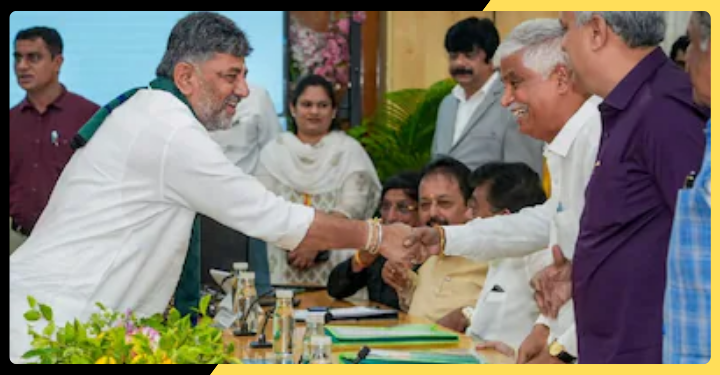
The Karnataka Congress government is grappling with a growing internal crisis after a recent Cabinet reshuffle triggered discontent among several party legislators. What was intended to strengthen the administration and improve governance has instead exposed deep factional divisions, leading to the resignation of two Congress MLAs and raising fears of further rebellion within the ruling party. The political developments have placed the state leadership under increasing pressure to restore unity before the situation escalates further.
The Cabinet changes came after weeks of consultations involving the Chief Minister, senior state leaders, and the Congress high command. The objective was to strike a balance between experienced ministers and new faces while ensuring representation across Karnataka’s diverse regions and communities. However, the final list disappointed many legislators who had expected to be rewarded with ministerial positions after playing key roles in the party’s electoral success.
The resignations of two Congress MLAs have become the biggest setback following the Cabinet rejig. The legislators publicly expressed frustration over what they described as an unfair selection process. According to them, experienced lawmakers who had worked tirelessly for the party were ignored, while others received opportunities without sufficient justification. Their decision has intensified speculation that more dissatisfied legislators may take similar steps if their concerns are not addressed promptly.
Party insiders suggest that the resignations reflect broader dissatisfaction rather than isolated incidents. Several MLAs are reportedly unhappy with the distribution of Cabinet portfolios and believe the leadership failed to adequately consult them during the decision-making process. While many have chosen to remain silent publicly, political observers believe that frustration continues to build within sections of the ruling party.
Chief Minister Siddaramaiah has sought to contain the crisis by emphasizing that Cabinet formation is always a challenging process due to constitutional limitations. Since only a fixed number of ministers can be appointed, not every deserving legislator can be accommodated. He appealed to party colleagues to prioritize governance and public service over individual ambitions, stressing that the Congress government remains committed to fulfilling its promises to the people of Karnataka.
Deputy Chief Minister D.K. Shivakumar has also stepped in to reassure party workers and legislators. He stated that every elected representative plays an important role in the government’s functioning, regardless of whether they hold ministerial office. Shivakumar expressed confidence that internal differences could be resolved through dialogue and mutual understanding, urging dissatisfied leaders not to take decisions that could weaken the party.
The Congress high command is closely monitoring developments. Senior leaders in New Delhi are believed to be holding discussions with the Karnataka leadership to prevent further resignations and restore stability. Reports indicate that efforts are underway to meet disgruntled legislators individually, understand their concerns, and explore ways to accommodate their aspirations through future organizational appointments or subsequent Cabinet adjustments.
The opposition Bharatiya Janata Party (BJP) has used the controversy to criticize the Congress government. BJP leaders argue that the Cabinet reshuffle has exposed deep divisions within the ruling party and demonstrated its inability to manage internal affairs effectively. They claim the Congress is preoccupied with political infighting while important governance issues affecting the people of Karnataka remain unaddressed.
Political analysts note that such tensions are common after Cabinet expansions, especially in governments with a large number of experienced legislators aspiring for ministerial positions. With constitutional restrictions limiting the size of the Cabinet, disappointment among excluded leaders is often unavoidable. However, they emphasize that the manner in which party leadership handles dissatisfaction determines whether it remains a temporary disagreement or develops into a larger political crisis.
The unfolding situation also carries governance implications. Karnataka is currently focusing on infrastructure development, industrial investment, employment generation, agricultural support, and the implementation of welfare schemes. Prolonged political uncertainty could divert the government’s attention from these priorities, affecting administrative efficiency and public confidence.
Many Congress leaders continue to express optimism that the crisis will eventually be resolved. They point out that the party has successfully managed similar internal disagreements in the past through dialogue and consensus-building. Nevertheless, they acknowledge that immediate intervention is necessary to prevent the discontent from spreading further among legislators.
For the Congress leadership, the current episode represents an important test of political management. Maintaining unity within a party that enjoys a comfortable legislative majority requires balancing regional interests, factional aspirations, and individual expectations without compromising governance. Failure to do so could provide the opposition with additional opportunities to challenge the government both inside and outside the Assembly.
As political negotiations continue behind closed doors, all eyes remain on the Congress high command and the Karnataka leadership. Whether they succeed in persuading disgruntled legislators to remain within the party fold or face additional resignations will largely determine the government’s political stability in the months ahead. For now, the Cabinet reshuffle has transformed into a significant challenge that could shape Karnataka’s political landscape and test the resilience of the Congress government.
Journalist Details

Latest entries
 NewsSeptember 20, 2026Mumbai Coastal Road Tragedy: BMW Crashes Through Barrier, Three Young Lives Lost
 Latest NewsSeptember 17, 2026Aaditya Thackeray Denies Disha Salian Link as Father Issues Rs 500 Crore Notice
 Latest NewsSeptember 14, 2026‘I Felt Unsafe’: Gurugram Woman Biker’s Road Rage Ordeal Caught on Video
 Latest NewsSeptember 7, 2026‘Criticism Is Fine, Insults Are Not’: Vijay Redefines the Limits of Political Speech