
Centre Initiates Major Personnel Changes in Minister Bhupender Yadav’s Secretariat
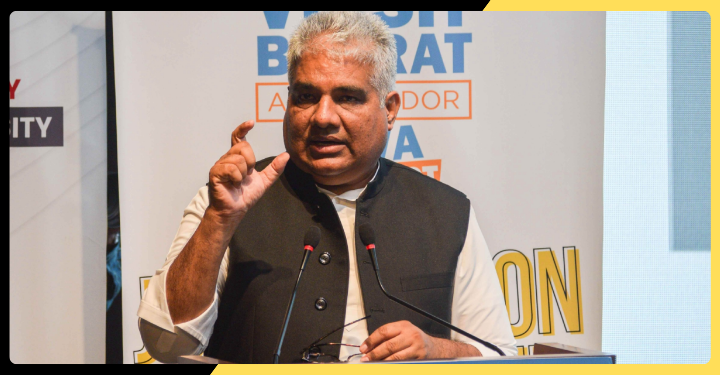
The Central Government has initiated a significant personnel reshuffle in the office of Union Minister Bhupender Yadav, removing his Private Secretary and two Additional Private Secretaries as part of an administrative reorganization. The development has generated considerable interest in bureaucratic circles, with officials describing it as an internal restructuring exercise aimed at strengthening the functioning of the minister’s secretariat.
Although the government has not publicly disclosed the reasons behind the changes, officials familiar with administrative procedures say such decisions are often taken after periodic reviews of ministerial offices. These reviews are intended to ensure that administrative teams remain efficient, responsive, and aligned with the government’s evolving priorities.
The office of a Union Minister plays a vital role in coordinating government business. Every official communication, policy proposal, parliamentary response, and meeting schedule passes through the minister’s secretariat before reaching the minister for consideration. As a result, the officials serving as Private Secretary and Additional Private Secretaries occupy positions of considerable responsibility.
The Private Secretary acts as the principal administrative aide to the minister, managing confidential correspondence, organizing official engagements, supervising file movement, and maintaining coordination with senior bureaucrats. Additional Private Secretaries assist in handling documentation, monitoring departmental communication, arranging meetings, and ensuring that instructions issued by the minister are conveyed to the concerned authorities without delay.
Officials say the simultaneous replacement of three senior members of the minister’s personal staff is an important administrative development, but it should be viewed within the normal framework of government functioning. Transfers, reassignments, and changes in ministerial support staff occur regularly across ministries as part of routine personnel management.
Sources indicate that the ministry has already begun the process of identifying suitable officers to fill the vacant positions. The appointments are expected to be made in accordance with established government procedures, with preference likely to be given to experienced officers capable of handling high-level administrative responsibilities.
Bhupender Yadav is entrusted with key responsibilities in the Union government, requiring continuous coordination with various ministries, state governments, parliamentary committees, and other stakeholders. His office manages a substantial volume of official work each day, making a well-organized support team essential for efficient governance.
Experts in public administration explain that ministerial secretariats function as the operational backbone of every ministry. While ministers are responsible for policy decisions, their support staff ensure that official processes move smoothly by coordinating meetings, preparing briefs, tracking files, and facilitating communication across departments. Any effort to strengthen these administrative systems is generally viewed as part of institutional capacity-building.
The recent reshuffle also reflects the government’s emphasis on administrative accountability and organizational efficiency. Ministries periodically evaluate staffing patterns to ensure that resources are being utilized effectively and that official work continues without unnecessary delays. Introducing new officers into key positions can bring fresh ideas, improved coordination, and renewed administrative focus.
Political observers have advised against interpreting the personnel changes as evidence of any policy disagreement or political development. In the Indian administrative system, transfers and staff reorganizations are common and are often driven by service requirements, tenure policies, or organizational restructuring rather than extraordinary circumstances.
Despite the personnel changes, officials have confirmed that the ministry’s daily operations remain unaffected. Existing officers continue to manage essential administrative work, ensuring that government files, policy discussions, parliamentary matters, and official meetings proceed according to schedule. This continuity is made possible through established institutional mechanisms designed to minimize disruption during staff transitions.
The appointment of new officers is expected in the near future, after which the reconstituted ministerial team will assume full responsibility for supporting the minister’s official engagements. Their role will include coordinating with senior government departments, facilitating policy implementation, managing confidential communications, and ensuring the smooth functioning of the minister’s office.
As the government moves forward with the restructuring process, attention will remain focused on the new appointments and the continued efficiency of the minister’s secretariat. The reshuffle highlights the importance of periodic administrative reviews in maintaining effective governance, ensuring institutional continuity, and supporting the delivery of government responsibilities in an increasingly complex administrative environment.
Journalist Details

- Jitendra Kumar is an Indian journalist and social activist from Hathras in Uttar Pradesh is known as the senior journalist and founder of Xpert Times Network Private Limited.
Latest entries
 BusinessAugust 31, 2026Family Says Justice Is Incomplete After Two Suspected Ankit Balyan Killers Die in Encounter
 Latest NewsAugust 27, 2026What Happened in Kanpur? DGCA Probe Begins After Fatal Training Aircraft Crash
 Latest NewsAugust 26, 2026Nepal Flash Floods Wreak Havoc Near Tibet Border, Roads and Bridges Washed Away
 Bharat StoriesAugust 26, 2026DJ Vaishal INDIA: Redefining the Art of Musical Journeys in India in 2026