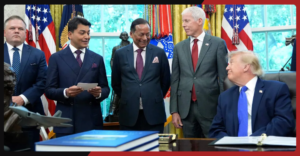
Trump Plane Switch Raises Questions Over Israeli Intelligence and Iran Threat

The secret flight that carried Donald Trump away from Turkey has become the center of a growing debate over intelligence reliability, presidential security and the role of Israel in warning Washington about Iranian threats.
Trump was in Ankara for a NATO summit in July when security officials reportedly decided that his departure required an unusual change of plan.
The president had arrived on a new aircraft donated by Qatar. But when he prepared to leave Turkey, he was publicly seen boarding an older Air Force One. The appearance was reportedly part of a security deception.
Trump was then secretly transferred to a smaller C-32A military aircraft, reportedly using a catering vehicle to conceal the movement. The aircraft carrying Trump flew toward Britain while the older Air Force One remained visible as a decoy.
The operation was reportedly prompted by concerns over an Iranian threat.
However, new reporting has revealed that American intelligence officials were not completely convinced by the information they had received.
The warning originated with Israel, which reportedly passed information to the CIA about an alleged Iranian plot targeting Trump. According to recent reports, CIA analysts judged the intelligence with low confidence and communicated their skepticism to officials in the Trump administration.
That revelation changes the way the episode can be understood.
Earlier reports portrayed the aircraft switch as a response to a credible and specific threat. Later accounts have suggested that while the Secret Service treated the threat seriously, parts of the US intelligence community were less convinced.
This difference is not unusual in national security operations.
Intelligence agencies can receive the same information and reach different judgments depending on the evidence available to them. One agency may believe that a warning deserves attention, while another may conclude that the information is too weak to confirm an immediate danger.
The Secret Service has a different responsibility.
Its job is to protect the president, not determine whether foreign intelligence is ultimately correct. That means officials can take protective action even when intelligence analysts remain uncertain.
The aircraft itself was another major factor.
Trump’s new presidential aircraft had been donated by Qatar and modified for US presidential operations. Although it was intended to meet security requirements, experts have noted that the plane was converted rather than purpose-built as a presidential aircraft.
The older Air Force One fleet has been designed around the unique requirements of presidential travel. It includes sophisticated defensive systems intended to protect against different forms of attack.
That distinction became particularly significant because the reported intelligence warning involved a possible missile threat.
One report said US officials had been told that someone near the NATO summit may have been seen with a shoulder-fired surface-to-air missile. Such weapons can be especially dangerous to aircraft near airports because they are designed to target aircraft from the ground.
The credibility of that information remains unclear.
There is no publicly available evidence proving that an Iranian-backed attacker was positioned to launch a missile at Trump’s aircraft.
That uncertainty is precisely what makes the CIA’s reported assessment important.
If the information was considered low confidence, why did the Secret Service execute such an elaborate operation?
The answer may be that security decisions are often based on risk rather than certainty.
The potential damage from a false alarm is limited: a president takes another aircraft, additional security personnel are deployed and travel becomes more complicated.
The potential damage from ignoring a genuine threat is far greater.
Officials therefore had strong reasons to choose caution.
The deception also provided an additional layer of protection. By allowing observers to believe Trump was aboard one aircraft while he actually traveled on another, security officials reduced the possibility that a hostile actor could predict his movements.
The operation reportedly involved only a small number of Trump’s aides. Other senior officials and journalists remained aboard the visible aircraft, helping preserve the deception.
Trump later said the Secret Service had directed the aircraft change and that he simply followed its instructions.
The episode has also sparked debate over whether the new presidential aircraft should be used in high-risk international environments.
The aircraft had only recently entered presidential service, making the Turkey trip an important test of its capabilities. The decision to move Trump away from it raised questions about whether officials had sufficient confidence in its defensive systems.
At the same time, the incident should not automatically be interpreted as evidence that the aircraft is unsafe.
Presidential security decisions are based on circumstances, and officials may prefer the aircraft with the most established defensive capabilities when traveling through regions experiencing heightened tensions.
The broader issue is the relationship between intelligence and policy.
Some US officials have reportedly questioned whether Israeli intelligence regarding Trump’s safety was intended partly to influence Washington’s approach toward Iran.
That remains an allegation, not an established fact.
Israel has strong intelligence capabilities relating to Iran, and its warnings can be extremely valuable to the United States. But US intelligence agencies are also expected to challenge information when they believe it lacks sufficient evidence.
The Turkey incident demonstrates that both realities can exist simultaneously.
Israel can provide an important warning.
The CIA can remain skeptical.
And the Secret Service can still decide that the president should be moved to safety.
That combination ultimately produced one of the most unusual presidential travel operations in recent memory.
Journalist Details

- Jitendra Kumar is an Indian journalist and social activist from Hathras in Uttar Pradesh is known as the senior journalist and founder of Xpert Times Network Private Limited.
Latest entries
 NewsSeptember 29, 2026Trump Unveils Essar-Backed Iowa Steel Project With 10 Million Ton Annual Capacity
 Latest NewsSeptember 28, 2026Delhi Orders 50% Work From Home as Government Targets Winter Air Pollution
 Latest NewsSeptember 27, 2026Rape Allegation Triggers Student Anger at LPU as Police Move In to Restore Order
 NewsSeptember 25, 2026Taiwan Remains One of the Most Sensitive Issues Between Washington and Beijing