A ‘Late Awakening’ in Europe: Why Modi’s Economic Warning Matters Today
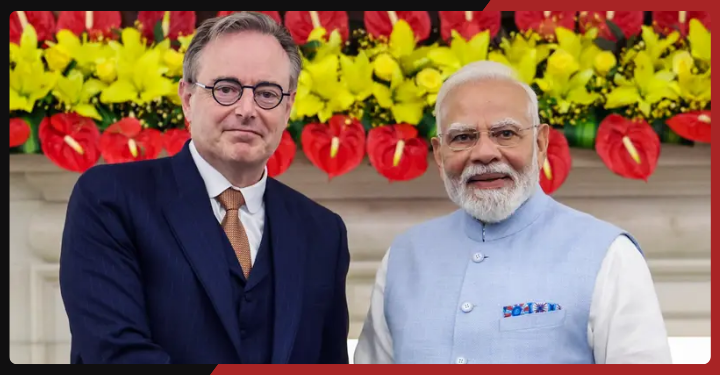
Belgian Prime Minister Bart De Wever’s description of Europe’s response as a “late awakening” has highlighted one of the most important debates shaping the modern global economy: how much dependence is too much?
For years, countries around the world embraced an increasingly interconnected economic system. Companies built supply chains across continents, industries relied on foreign suppliers and governments encouraged international trade.
But the world has changed.
Recent years have demonstrated that economic dependence can sometimes create serious strategic vulnerabilities.
When supply chains are disrupted, essential goods can become unavailable. When political tensions increase, trade relationships can become uncertain. And when countries rely too heavily on a limited number of suppliers, those dependencies can potentially be used as leverage.
Belgian Prime Minister Bart De Wever said Europe had learned this lesson the hard way.
During his visit to India, he acknowledged that India had recognised these dangers earlier. He said Prime Minister Narendra Modi had warned Europe, but Europe did not listen at the time.
Now, according to De Wever, Europe is listening.
The statement is significant because it represents a major shift in the way economic security is being discussed.
In the past, economic policy was often focused primarily on growth, efficiency and lower costs.
Today, governments are also thinking about resilience.
They are asking whether supply chains can survive crises.
They are examining whether critical technologies are controlled by reliable partners.
And they are considering whether economic relationships could become geopolitical vulnerabilities.
India has increasingly focused on these issues.
The country’s emphasis on domestic manufacturing, technology development and diversified international partnerships reflects a broader strategy of reducing excessive vulnerabilities while remaining connected to the global economy.
This does not mean rejecting international trade.
Instead, it means ensuring that dependence does not become dangerous.
De Wever’s comments suggest that Europe is moving closer to this way of thinking.
The Belgian leader spoke about the importance of finding partners who believe in cooperation based on trust and respect.
India has become increasingly attractive in this context.
The country combines a massive market with growing industrial capacity and a strong technology sector. It also has strategic relationships with countries across the world.
For Europe, closer engagement with India could help diversify supply chains and create new economic opportunities.
For India, stronger ties with Europe could provide access to investment, advanced technology and expanded markets.
The growing India-Belgium partnership demonstrates this trend.
The two countries have identified important areas for cooperation, including defence, clean energy, critical minerals, semiconductors and research.
These sectors are especially important because they will influence the global economy of the future.
The debate is therefore much bigger than one diplomatic statement.
It concerns how countries will organise their economies in an increasingly uncertain world.
Should nations rely heavily on the cheapest available suppliers?
Or should they pay greater attention to security, resilience and trust?
Europe appears to be moving towards the second approach.
De Wever’s statement suggests that India’s earlier warnings are now being viewed differently.
What may once have been ignored is now becoming part of Europe’s strategic thinking.
The “awakening” may have come late, as the Belgian Prime Minister admitted.
But it could lead to major changes.
India and Europe may now find themselves closer than ever in their understanding of economic security.
And that shared understanding could reshape trade, technology and diplomacy for years to come.
Journalist Details

Latest entries
 NewsOctober 22, 2026Saudi Airport Attack Raises Fresh Concerns Over Security of Civilian Infrastructure
 NewsOctober 12, 2026INDIA Bloc Raises Vote Theft Concerns as CJI Directs Attention to Legal Process
 NewsOctober 5, 2026Runoff Looms in Brazil as Bolsonaro’s Lead Narrows During Vote Count
 Latest NewsOctober 1, 2026Tennessee Halts Executions After Christa Pike Survives Death Sentence Attempt